Chapter 3
Military Campaigns
The conquests ordered by Ghiyasuddin Tughlaq that destroyed kingdoms, desecrated temples, and transferred the wealth of Hindu civilizations to Delhi.
The conquests ordered by Ghiyasuddin Tughlaq that destroyed kingdoms, desecrated temples, and transferred the wealth of Hindu civilizations to Delhi.
The Kakatiya dynasty had ruled the Deccan from their capital at Warangal (modern Telangana) for over two centuries. Under Prataparudra II, the Kakatiyas presided over a flourishing Hindu civilization renowned for its temple architecture, Sanskrit scholarship, and trade. Ghiyasuddin Tughlaq sought to destroy this independent kingdom and loot its legendary wealth.
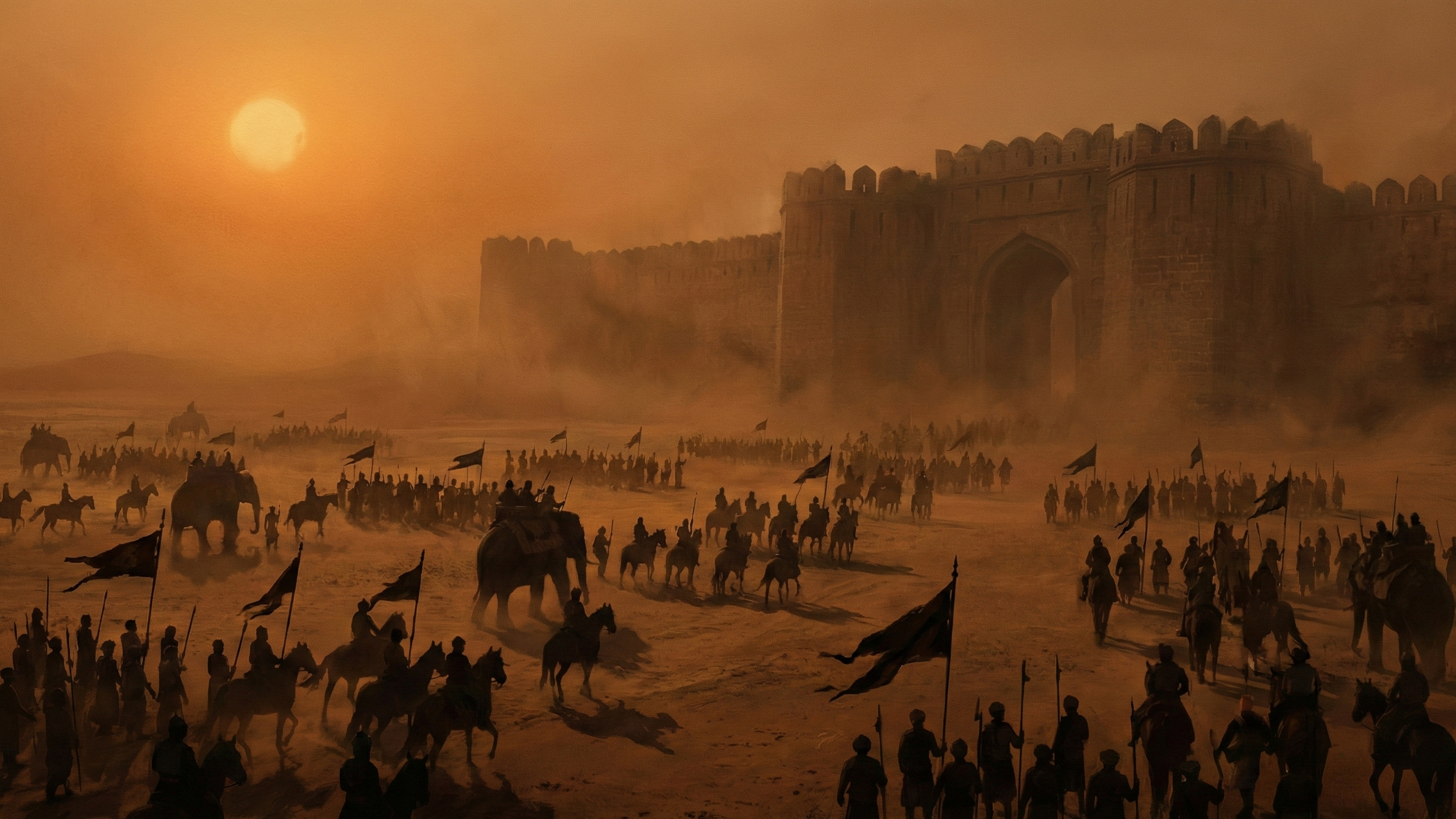
Ghiyasuddin sent his son Ulugh Khan (future Muhammad bin Tughlaq) with a massive Sultanate army to conquer Warangal. The Kakatiya forces under Prataparudra II put up fierce resistance. Internal disputes among Sultanate commanders and supply difficulties forced Ulugh Khan to retreat. Ghiyasuddin, undeterred, immediately began planning a second, more devastating campaign.
The failure of the first campaign is documented in both Barani's Tarikh-i-Firoz Shahi and multiple secondary analyses of the period. Ghiyasuddin's response was to send reinforcements, demonstrating his personal commitment to the destruction of the Kakatiya kingdom.
The second campaign succeeded. Ulugh Khan, with reinforced armies, besieged Warangal and forced Prataparudra II to surrender. What followed was systematic destruction:
The last Kakatiya king, Prataparudra II, was captured and sent to Delhi as a prisoner. According to multiple historical accounts, he died en route — either from the humiliation and hardship of captivity, or by his own hand to avoid the disgrace of being paraded before the Sultan. With his death, the Kakatiya dynasty — a civilization that had flourished for over two centuries — was permanently extinguished.
The following major temple sites were documented as destroyed, desecrated, or plundered during the Sultanate campaigns against the Kakatiya kingdom:
The sacred Svayambhu (self-manifested) Shiva Temple within the Warangal Fort complex was desecrated as a deliberate symbol of the Sultanate's victory over the Kakatiya Hindu kingdom. The temple was one of the most revered sites in the Deccan.
A masterpiece of Kakatiya architecture dedicated to Shiva, Vishnu, and Surya. Built in 1163 CE with star-shaped platform and intricately carved pillars. Plundered and desecrated during the Tughlaq invasion of the Deccan.
A group of Kakatiya-era temples known for their ornate Chalukyan-style architecture. Plundered during the 1323 invasion. The complex survives in a damaged state to this day, bearing testimony to the destruction inflicted by the Sultanate forces.
In 1323–24 CE, Ghiyasuddin Tughlaq personally led a military campaign to suppress Bengal, where the governor Ghiyasuddin Bahadur Shah had declared independence. The Sultan marched across eastern India with his army, defeated the rebel governor, and reasserted Sultanate control over the resource-rich region of Bengal. It was during his return from this campaign that he met his suspicious death at the collapsed pavilion.
Ghiyasuddin's forces also attacked the Hindu kingdom of Tirhut (Mithila) in modern Bihar. Mithila was one of India's most ancient centers of Sanskrit learning and Hindu scholarship, with a civilizational tradition stretching back millennia. The Sultanate subjugation of this region had significant implications for the continuity of Sanskrit intellectual traditions in eastern India.
Amir Khusrau's Tughlaq Nama provides a particularly revealing account of what happened after military victories. He records that:
This systematic religious discrimination was not incidental — it was policy. The military of the Delhi Sultanate under Ghiyasuddin Tughlaq operated on the explicit principle that Hindu and Muslim soldiers would be treated differently based on their religion.